How Linguapop works
By Linguapop Team ·

This is a short story on how Linguapop came to be, how our rating system was inspired, and how we decided to tackle a problem every language school faces when faced with new candidates - language placement testing.
Our story begins in a rather unusual place - the online leaderboard of Tetris Effect, a modern version of the time-old classic video game Tetris which features online multiplayer competitions. Jure, our lead developer, in addition to creating ed-tech solutions for the last 10 years, is an avid Tetris player, and is fiercely competitive in multiplayer games.
An ages-old problem in online multiplayer games is ensuring that every match you play is engaging, challenging, and most importantly fun. This can only be achieved if players of near-equal skill-levels are matched against each other. The developers of these games spend considerable effort on creating matchmaking systems that track a player's performance in order to quickly assess their skill level and match them against similarly-skilled opponents.
Back to Jure - he noticed how, after only a couple dozen matches of Tetris Effect's online multiplayer, all of which resulted in wins in Jure's favor, he got placed in the top 1% of players globally. The matchmaking system figured out his skill level extremely quickly and started giving him challenging opponents. The system worked - Jure was happy to have engaging matches, and lower-skilled players were happy to not be matched against him.
Working with language schools has given Jure insight into how they operate, and one problem they always had was the issue of assessing the language skill level of their newcomers. Of course, placement tests exist, but they usually end up either being a paper-based affair, an online form that could have just as equally been paper, or were simply hard to administer - something that's especially problematic during a school's chaotic enrollment periods, when every second and every click counts. The tests were simply a point of necessary friction, both for the candidate and the school.
Worst of all, they would sometimes wildly miss their candidate's language skill level, thus producing a candidate who is unhappy with their class - whether it was too simple or too hard.
Thus the idea of an adaptable, quick, and easy to administer placement test was born. With this in mind, we settled on three main goals:
- Make the placement test behave like matchmaking in multiplayer games, quickly adjusting to the candidate's skill level.
- Align the test with a common language skill assessment platform - the Common European Framework of Reference, also known as CEFR.
- Make sure that the test can be delivered within less than 30 seconds per candidate.
Linguapop's matchmaking system
All matchmaking is designed to represent the relative skill levels of competitors of a certain game or sport. Chess, table tennis, Starcraft, Counter-Strike and others all use their own matchmaking systems which aim to allow skilled players to quickly rise through the ranks and get matched with equally skilled opponents.
At Linguapop, we decided to develop a language-agnostic rating system which pits candidates against a series of language tasks appropriately suited for their language skill level.
We achieved this by treating language tasks like players in a multiplayer game. We assume that each language task has a specific matchmaking rating, same as the candidate. The candidate's rating changes based on how they perform while solving the tasks, essentially making each task a small competition of candidate vs. task.
This approach has proven to quickly adapt to the candidate's skills, giving them challenging and engaging tasks after only 10-15 solved tasks, and giving schools reliable results within 40-60 tasks solved. The entire idea of our matchmaking approach is to keep your candidates in the "sweet spot" - giving them tasks just hard enough to be engaging, while not overwhelming or boring them with tasks they cannot solve, or they just get bored of.
As our matchmaking algorithm progresses, it becomes more and more sure of the candidate's actual skill level. Once it's sure enough, it ends the test and gives both you and your candidate a realistic assessment of their language skill level.
We also made sure to include different kinds of tasks, such as gap-filling exercises and multiple choice questions, so that candidates never get tired of filling out the same kind of questions.
The best part of the matchmaking approach? It's completely language-agnostic. It works for all languages, as long as Linguapop has a large-enough database of questions for the language in question. Thanks to this, we made a placement testing system that works for English, German, Spanish, Italian and French, with more languages to come!
Alignment with CEFR
The Common European Framework of Reference for Languages (CEFR) is a globally recognized framework that standardizes the levels of language proficiency across different languages. Developed by the Council of Europe, the CEFR provides clear guidelines and descriptors for teaching, learning, and assessing a variety of languages. It helps to understand and describe language ability, simplifying communication about linguistic skills.
The CEFR scale consists of six levels: A1 and A2 (basic user), B1 and B2 (independent user), and C1 and C2 (proficient user). These levels provide a detailed understanding of a language learner's proficiency, creating a comprehensive approach to language education and maximum transparency of linguistic progress.
At Linguapop, we worked with schools to determine how we could best align Linguapop with two main factors: the CEFR scale, and how schools actually place and educate students.
We quickly found out that most of their existing students are on either the B1 or B2 levels for their respective language. Furthermore, students spend the longest time learning at these levels. This means that schools subdivide the B1 and B2 levels into submodules usually labeled by another number, for example B1.1 through B1.4, and B2.1 through B2.4. Now, this happens for A and C-levels too, but not to the extent the B-levels have shown.
With this in mind, we have decided to split the CEFR from its original 6 levels into a new, 16-level system which directly corresponds to the CEFR:
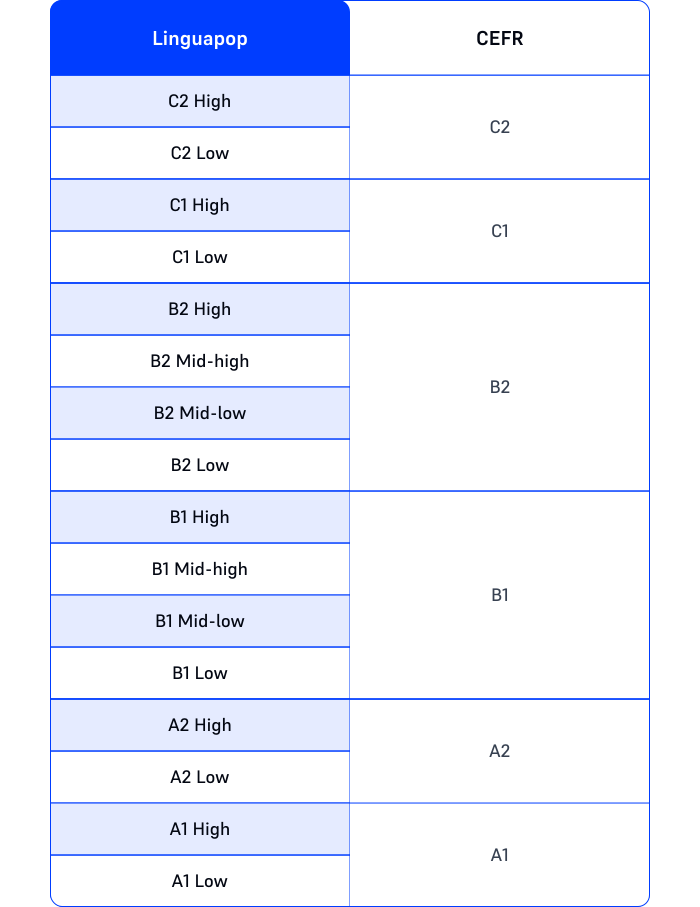
As you can see, the A and C-levels are subdivided into two sub-levels each. Each one of these sub-levels corresponds to a lower and higher placement within the level. The B-levels are subdivided into four sub-levels each, roughly following the bell-curve nature of the distribution of language learners' skills.
This subdivision was decided upon for two main reasons:
- The first reason is that it makes it easier for schools to know which course/module to enroll their candidates in.
- The second reason ties back to our algorithm. With most of the work with students happening at the B-levels, it only makes sense to ensure that there is more granularity of rating at these levels.
We understand that each school, alongside the textbook publishers they work with, has its own system of ranking their students' language skill levels. Our approach aims to give the school enough granularity to place their students into classes that will provide the exact amount of challenge that promotes learning, while being adaptable to each school's approach.
In the end, it's up to you, our user, the school, to decide which class to place your student in. Linguapop aims to give you the best approximation of where that student belongs.
Ease of use - ease of mind
Ask yourself: when do you enroll most of your students? In our experience, this mostly happens in two periods - during the beginning of one or two of your main semesters. This is an insanely hectic time for all schools. You must ensure that all groups have enough students, organize schedules that work around students' timetables, and, on top of it all, you have to make sure your new students are placed in the right groups.
We can't possibly aim to solve all of these problems, but we can at least try to make one of these challenges as easy as possible - placement testing.
We specifically designed Linguapop to be as simple as possible to use:
- Need to test a candidate? All you need is an e-mail address or telephone number. Yes, even the student's name is optional. With Linguapop, you will be administering placement tests within 30 seconds of opening your browser window - whether you're on your PC or smartphone.
- Don't want to use one more piece of software in your enrollment workflow? No problem - connect Linguapop with your own CRM using the Linguapop API and send placement tests directly through your CRM.
- Don't have a CRM? Connect Linguapop with a Google Sheets file through our Zapier integration.
- Have a WhatsApp Business account? Send tests to candidates directly via WhatsApp - no e-mail needed.
- You want to use placement tests as a marketing tool? Use our API or Zapier integration to deliver your own, branded placement tests directly from your website.
And with this ease of use, we needed to make sure that you, the user, are never punished for using Linguapop. You should never have to take costs into consideration when trying to market your school to potential students. This is why we made the decision to only charge for completed placement tests. You can invite as many candidates as you wish - only those placement tests that reach an end and provide you with a final result will count towards billable charges.
Our core belief is that we should design software using empathy first, and sprinkling just a touch of high-tech on top to make a truly magical experience for our users.
Linguapop is a culmination of a decade of our experience working in ed-tech, accomplishments and failures included. It is an attempt at creating a solution to a problem that all language schools face, and one that fits all schools - both small and large.
We warmly welcome you to try out Linguapop. Allow us to demo it for you. And, especially, let us hear what you think.
The Linguapop team